
Are Big Investors Controlling the Housing Supply? The Truth Explained.
Lately, it feels almost impossible to browse online without running into a familiar statement:
“Big investors are buying up all the homes.”
If you’re a buyer who’s missed out on multiple offers, that claim probably sounds convincing. With high prices and fierce competition, it’s easy to believe large corporations are quietly snapping up properties behind the scenes.
But there’s an important distinction to make: public perception doesn’t always line up with what the data actually shows.
So let’s take a closer look at what’s really going on with large institutional investors in today’s housing market—because the facts paint a very different picture than the headlines suggest.
The Stat Most People Don’t Hear About
Here’s the key number many articles overlook. Data from John Burns Research & Consulting (JBREC) shows that large institutional investors—defined as those owning 100 or more homes—accounted for just 1.2% of all home purchases in Q3 of 2025.
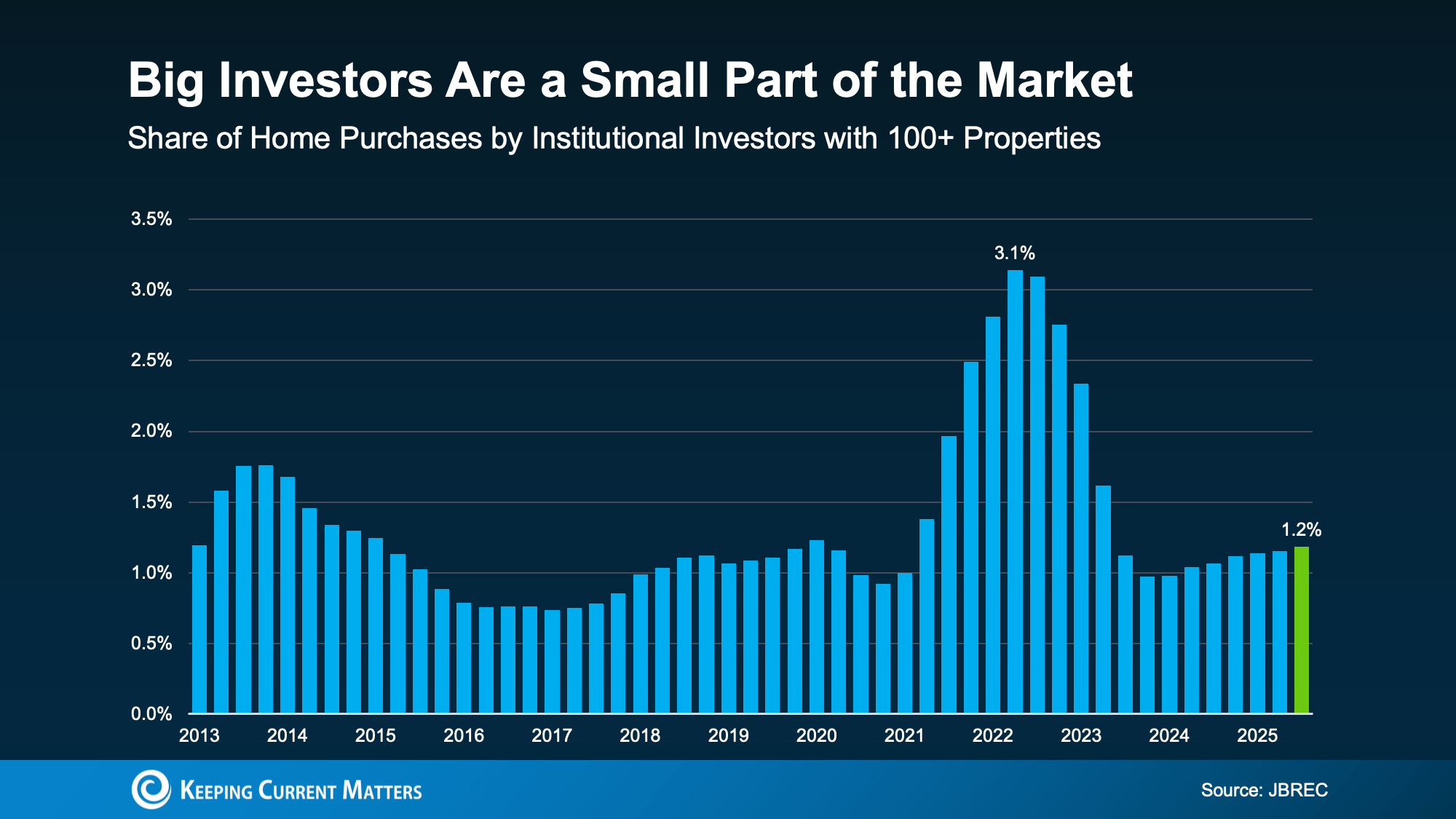
Put another way, out of every 100 homes sold, only about one was purchased by a large institutional investor.
Even more important, this level of activity isn’t unusual. It closely matches long-term historical averages and is significantly lower than the 2022 peak of 3.1%, which was still a relatively small portion of total sales.
While it may feel like investors are everywhere, on a national scale, they make up only a tiny slice of the market.
Why Investor Activity Feels Bigger Than It Is
There are two main reasons this narrative gets so much attention:
Investor activity is concentrated, not evenly distributed.
In certain regions, investors are more active, which can intensify competition for buyers in those local markets. As ResiClub Co-Founder Lance Lambert explains, while large investors own only about 1% of the nation’s single-family housing stock overall, their presence is more noticeable in select metro areas.
The term “investor” is often misunderstood.
Many headlines group large Wall Street firms together with small-scale investors—like individuals who own one or two rental properties. These are very different types of buyers. In reality, the majority of investors are local, small-scale owners, not massive corporations. When all investors are combined into one statistic, it creates the impression that big institutions are dominating the market—even though they aren’t.
Yes, large investors do buy homes. But nationwide, they represent a very small share of total purchases—far less than most people assume.
The real drivers behind today’s affordability challenges are long-standing issues like limited housing supply, strong demand, and years of underbuilding—not institutional investors crowding out everyday buyers.
That’s why separating fact from noise is so important, especially if you’re trying to decide whether now is the right time to make a move.
Bottom Line
If you want to understand what investor activity looks like in your local market—and whether it actually affects your buying or selling options—a conversation with a local real estate agent can help.
Sometimes, having the right context makes all the difference.


